
BMX Frame Material Guide: Aluminum vs. Chromoly & 6069 vs. 7005
Selecting between chromoly steel, 6061, 7005, and 6069-T6 aluminum dictates gate acceleration, lateral stiffness, and frame fatigue life. Here is the engineering breakdown for competitive BMX racing
Key TakeawaysChromoly vs. Aluminum: 4130 Chromoly offers high tensile strength and impact absorption for freestyle, but its higher density creates a weight penalty that reduces gate acceleration in BMX racing.The 24-Inch Myth: A "24-inch BMX" refers to wheel diameter (Cruiser class), not the frame's top tube measurement. Top tube sizing for adult race frames typically ranges from 20.5 to 21.75 inches.6069-T6 vs. 7005-T6: 6069-T6 aluminum outperforming 7005-T6 with ~30% higher yield strength (~380–414 MPa vs. ~290 MPa) and full weld-zone recovery during liquid-quench T-6 heat treatment.Component Matching: Running aluminum forks or handlebars on a race setup drops unsprung weight, but rider weight thresholds (>110 lbs / 50 kg) dictate moving to stiff chromoly or carbon forks to prevent steering deflection.
Selecting the optimal BMX frame material requires balancing weight, structural rigidity, yield strength, and fatigue resistance. While casual riding and street freestyle prioritize impact tolerance and crash resistance, BMX track racing demands maximum lateral stiffness for gate power transfer and minimized overall weight.
Misconceptions regarding frame sizing, alloy strength, and component compatibility frequently complicate purchasing decisions. This engineering guide breaks down the physical properties of Chromoly steel versus modern aluminum alloys (6061-T6, 7005-T6, 6069-T6) and clarifies how material selection impacts track performance.
1. Frame Geometry Demystified: Sizing & Nomenclature
A common point of confusion is frame sizing vs. wheel sizing. Statements referencing a "24-inch frame" confuse top tube length with wheel diameter.
- Standard 20-Inch BMX: Uses 20-inch wheels. Top tube (TT) lengths vary from 18 inches (Junior/Expert) up to 21.75 inches (Pro XXXL) to accommodate rider height.
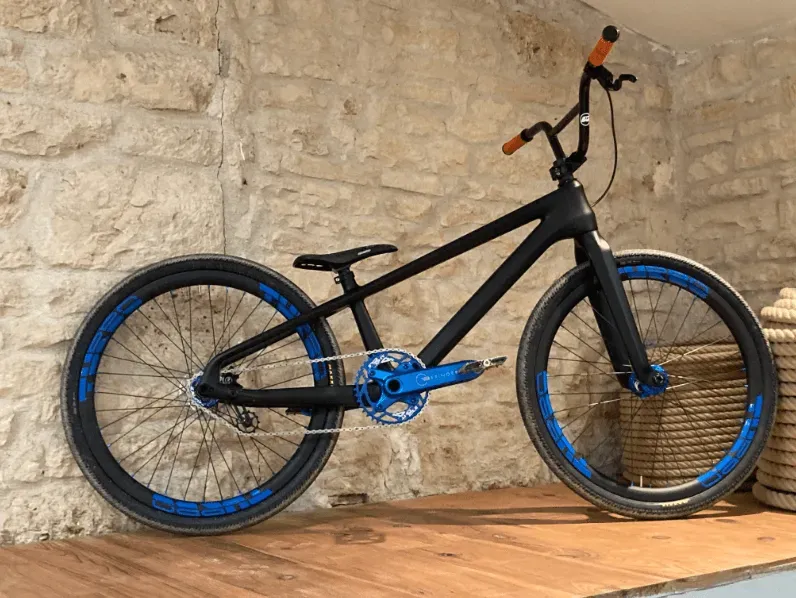
- 24-Inch Cruiser Class: Refers to bikes built around 24-inch wheels. These frames utilize longer top tubes and altered bottom bracket drops for stability over longer, smoother race layouts.
| Frame Component | Technical Description | Performance & Geometric Impact |
|---|---|---|
| Top Tube (TT) | Upper main tube connecting Head Tube to Seat Tube (20.5" - 21.75") | Determines rider reach, cockpit clearance, and high-speed stability. |
| Head Tube | Front junction housing the fork steerer and headset bearings | Angle dictates steering response rate and front-end stability. |
| Down Tube | Primary load-bearing tube linking Head Tube to Bottom Bracket | Absorbs frontal impacts and handles torsional flexing during sprinting. |
| Bottom Bracket (BB) | Threaded or press-fit shell housing the crankset spindle | Lower BB height lowers center of gravity for improved cornering stability. |
| Chain Stay (CS) | Rear lower tubes connecting BB shell to rear dropouts | Shorter stays increase manual agility; longer stays enhance straight-line gate stability. |
| Seat Stay | Rear upper tubes supporting the seat tube junction | Transmits rear-wheel braking forces and influences vertical compliance. |
| Dropouts | Axle slot junctions at the rear triangle | Holds the rear hub axle and allows chain tension adjustment. |
2. Structural Metallurgy: Chromoly Steel vs. Aluminum
The fundamental choice in frame construction lies between 4130 Chromoly Steel (Chromium-Molybdenum) and Aluminum Alloys. Neither material is universally "faster"—speed depends on rider power output, power transfer efficiency, and overall system weight.
| Frame Material | Structural Properties | Riding Performance & Best Advantage |
|---|---|---|
| 4130 Chromoly Steel | High density, high tensile strength, natural material compliance | Impact Absorption: Absorbs high-impact landings & violent track force |
| Aluminum Alloy | Low density, high lateral rigidity, highly formable tubing | Sprint Efficiency: Maximum power transfer & rapid gate acceleration |
Material Property Comparison
| Property / Metric | 4130 Chromoly Steel | 6061-T6 Aluminum | 7005-T6 Aluminum | 6069-T6 Aluminum |
| Density | ~7.85 g/cm³ | ~2.70 g/cm³ | ~2.78 g/cm³ | ~2.71 g/cm³ |
| Yield Strength (MPa) | ~460–600 MPa | ~276 MPa | ~290 MPa | ~380–414 MPa |
| Tensile Strength (MPa) | ~560–700 MPa | ~310 MPa | ~350 MPa | ~410–448 MPa |
| Primary Advantage | Fatigue resistance & compliance | Cost-effective stiffness | High static strength | Highest strength-to-weight & full weld recovery |
| Primary Use Case | Street / Park / Freestyle | Entry-Mid Race | Legacy Premium Race | Modern Elite Alloy Race |
Mechanical Behavior on the Track
- Gate Acceleration & Lateral Stiffness: Aluminum's lower density allows tube diameters to be increased without adding excess mass. Larger outer tube diameters dramatically improve torsional rigidity at the bottom bracket shell, reducing energy loss during initial gate launches.
- Impact Absorption vs. Energy Transfer: Chromoly flexes under heavy loads and returns to its original shape, making it ideal for high-impact landings in park and street applications. However, this vertical and lateral compliance absorbs power during out-of-the-saddle sprinting.
- Component Weight & Rider Thresholds: Aluminum bars and forks cut weight for lightweight riders (under ~110 lbs / 50 kg). Heavier or more aggressive adult racers require the yield strength of heat-treated 4130 Chromoly or carbon fiber for steering components to prevent sudden bending or failure under heavy landing forces.
3. Deep Dive: 6069-T6 vs. 7005-T6 Aluminum Alloys
For over a decade, 7005-T6 aluminum was the standard material for premium metal race frames due to its static strength. However, advancements in alloy chemical composition and heat treatment have positioned 6069-T6 as the superior engineering choice for modern race frames.
Alloy Yield Strength & Stress Tolerance
- 6069-T6 Aluminum (~380–414 MPa): Highest yield strength in its class. Provides up to 40–45% higher strength over standard 6061-T6, offering maximum power transfer off the starting gate.
- 7005-T6 Aluminum (~290 MPa): Mid-range static rigidity. Slightly stronger than 6061-T6, but subject to weld-zone fatigue limits due to air-quench processing.
- 6061-T6 Aluminum (~276 MPa): Standard baseline for race frames. Reliable, cost-effective structural strength with good all-around fatigue life.
The Role of Chemical Additives
- 7005 Alloy: Relies primarily on Zinc (4.0%–5.0%) and Magnesium for strength. While strong, it exhibits lower fracture toughness and higher susceptibility to stress cracking during rapid cooling.
- 6069 Alloy: Formulated with Magnesium, Silicon, Copper, and a key refining element: Vanadium (0.10%–0.30%). Vanadium refines the internal crystal grain structure, simultaneously raising yield strength, fracture toughness, and fatigue resistance.
Chemical Composition Breakdown
| Element | 6069 Alloy Formula | 7005 Alloy Formula | Structural Effect |
| Aluminum (Base) | ~96% | ~93% | Core material matrix |
| Zinc (Zn) | Trace | 4.0% – 5.0% | Main strengthener in 7xxx series |
| Magnesium (Mg) | 1.2% – 1.6% | 1.0% – 1.8% | Improves strain hardening |
| Silicon (Si) | 0.6% – 1.2% | Trace | Forms $Mg_2Si$ precipitates for heat-treatment response |
| Copper (Cu) | 0.55% – 1.0% | Trace | Enhances tensile properties |
| Vanadium (V) | 0.10% – 0.30% | None | Refines grain boundaries, boosting fatigue life |
Weld-Zone Integrity & Heat Treatment (T-6 Process)
A critical factor in frame longevity is how heat-affected zones (HAZ) recover after TIG welding:
- 7005 Air Quenching: 7005 alloy cannot withstand rapid liquid quenching after welding without risk of stress corrosion cracking. It undergoes air quenching, which only partially restores the metal's strength along weld seams.
- 6069 Liquid Quenching: As part of the 6xxx series, 6069 responds fully to complete T-6 heat treatment (solution treatment, liquid quench, and artificial aging). This restores maximum mechanical properties across the tube body and directly at the weld junctions.
4. Full BMX Race Frame Material Hierarchy
To evaluate where these metals fit relative to modern alternatives like Titanium and Carbon Fiber, consult the hierarchy below:
Tier 1: Elite / Ultimate (Pro Race)
- Materials: High-Modulus Carbon Fiber (Toray T1100K-S / M40X / M46X)
- Performance: Maximum stiffness-to-weight ratio, zero power loss under gate launch.
- Target Application: World Cup, Olympic-level, and professional racers.
Tier 2: Advanced Performance (Elite Alloy & Standard Carbon)
- Materials: 6069-T6 Aluminum (Full Liquid-Quench T-6), Aerospace Carbon (Toray T700/T800), Titanium.
- Performance: Full weld-zone strength recovery, exceptional fatigue resistance, optimized vertical compliance.
- Target Application: Competitive amateur and national-level track racers seeking peak metallic frame performance.
Tier 3: Competitive Standard (Mid-Level Race)
- Materials: 7005-T6 Aluminum, 6061-T6 Aluminum, Premium Butted Chromoly (Reynolds Steel).
- Performance: High static rigidity, cost-effective racing platform, air-quenched weld structures.
- Target Application: Local club racers and intermediate track competitors.
Tier 4: Freestyle / Entry Level (Park, Street & Casual)
- Materials: Standard 4130 Chromoly Steel, Trimoly, Hi-Tensile Steel.
- Performance: High impact tolerance, heavy energy absorption, budget-friendly crash resistance.
- Target Application: Street, skatepark, pump track, and entry-level street riding.
5. Frequently Asked Questions (FAQ)
Is a chromoly BMX frame faster than an aluminum race frame?
No. Material alone does not determine speed, but aluminum is engineered for higher lateral stiffness at a significantly lower overall mass. Chromoly steel absorbs vertical shock efficiently, but its natural lateral compliance allows minor flexing during gate launches, resulting in lost power transfer efficiency compared to aluminum.
What does a 24-inch BMX frame actually mean?
A "24-inch BMX" refers to the wheel diameter class (known as Cruiser Class), not the top tube frame measurement. Top tube lengths on adult BMX race frames typically range from 20.5 inches to 21.75 inches depending on rider height.
Why is 6069-T6 aluminum replacing 7005-T6 in modern race frames?
6069-T6 aluminum contains Vanadium grain refiners, achieving a yield strength of ~380–414 MPa compared to ~290 MPa for 7005-T6 (a ~30% increase). Additionally, 6069 tolerates full liquid-quench T-6 heat treatment after TIG welding, restoring 100% of material strength across weld zones.
Should adult BMX racers use aluminum forks and handlebars?
Aluminum handlebars and forks are generally recommended for junior racers under 110 lbs (50 kg). Adult riders generating high gate torque should opt for heat-treated 4130 Chromoly or carbon fiber steering components to prevent unexpected bending or material failure under severe landing loads.
How does frame fatigue life differ between 6061, 7005, and 6069 aluminum?
6069-T6 provides the highest fatigue resistance among aluminum alloys. Its fine grain structure and complete weld-zone recovery enable it to withstand repetitive cyclic stress (gate launches, jump landings) far longer than air-quenched 7005-T6 or baseline 6061-T6.
6. Engineering Summary & Selection Framework
Choosing the correct BMX frame material comes down to the specific physical demands of your riding discipline:
- For Street, Park, and High-Impact Riding: Select 4130 Chromoly Steel. Its elastic deformation properties prevent sudden structural failures during heavy crash landings and street grind impacts.
- For Entry-to-Mid Level Racing: Select 6061-T6 or 7005-T6 Aluminum. These alloys offer a cost-effective introduction to competitive track racing with lightweight handling and strong gate responsiveness.
- For High-Performance Metallic Track Racing: Select 6069-T6 Aluminum. With superior yield strength (~380–414 MPa), full liquid-quench heat-treatment recovery, and Vanadium-refined fatigue life, 6069 represents the pinnacle of metallic BMX race frame engineering.
- For Elite / Pro Track Racing: Select High-Modulus Carbon Fiber. When every millisecond off the start hill counts, carbon fiber delivers unmatched power transfer and stiffness-to-weight metrics.


Comments ()