
Aluminum vs. Stainless Steel Kitchen Cabinets: An Engineering & Cost Comparison
A complete engineering and architectural breakdown comparing aluminum profiles against 304 stainless steel cabinetry for indoor and outdoor kitchens.
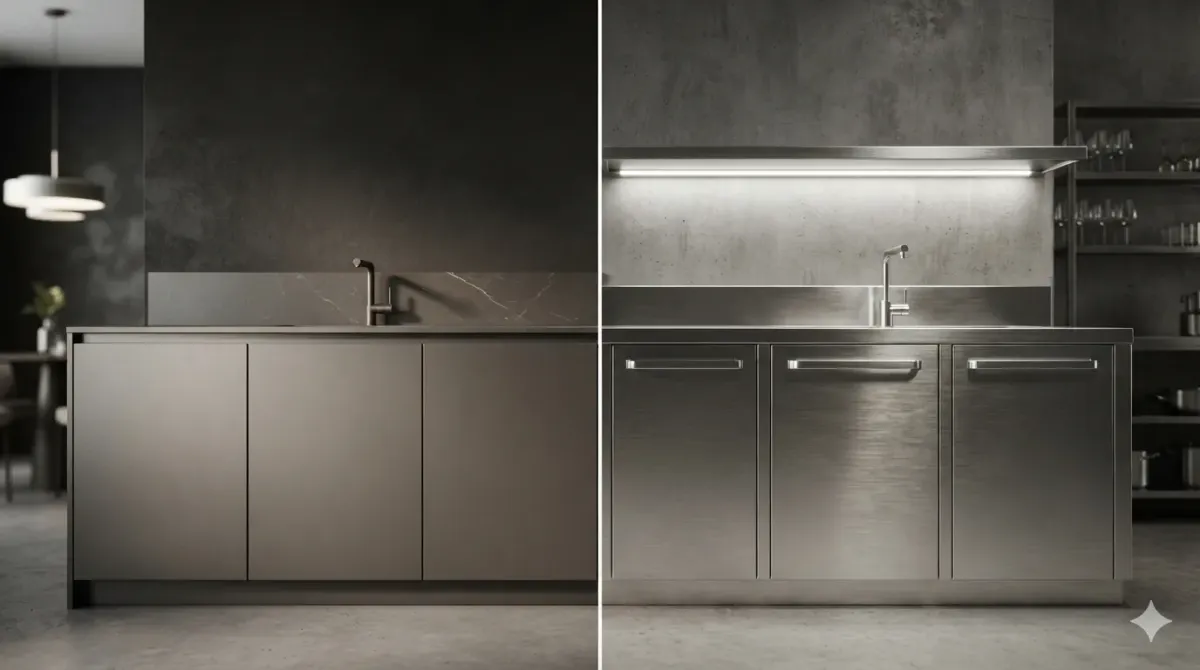
Choosing between aluminum and stainless steel kitchen cabinets comes down to balancing weight, environmental exposure, aesthetic customization, and long-term budget. While wood has traditionally dominated residential kitchens, metal cabinetry has surged in popularity due to its zero-formaldehyde emissions, 100% pest proofing, and exceptional resistance to water damage.
However, aluminum extrusions and stainless steel sheets perform distinctly under thermal stress, mechanical impact, and corrosive environments. This comprehensive comparison evaluates physical properties, cost profiles, and real-world application scenarios to guide your selection.
Key Takeaways
- Aluminum Cabinets are lightweight, cost-effective ($180–$250/linear ft), inherently rust-proof, and offer extensive finish customization via powder coating or anodization.
- Stainless Steel Cabinets (Grade 304) provide superior structural strength, higher impact resistance, and extreme heat tolerance, but command a higher price tag ($300–$450/linear ft).
- Indoor Wet/Coastal Kitchens: Aluminum excels due to absolute oxide protection against salt fog and humidity.
- Heavy-Duty & Outdoor Cooking: Grade 304 stainless steel is preferred for thermal endurance and heavy load capacities near high-Btu appliances.
Material & Physical Comparison
Understanding the structural differences between extruded aluminum alloy profiles and cold-rolled stainless steel sheets is essential for assessing load capacities and cabinet lifespan.
| Performance Factor | Extruded Aluminum Cabinets | 304 Stainless Steel Cabinets |
|---|---|---|
| Average Cost / Linear Foot | $180 – $250 | $300 – $450 |
| Density & Weight | ~2.7 g/cm³ (Lightweight) | ~8.0 g/cm³ (Heavy) |
| Tensile Strength | Moderate to High (6063-T5) | Superior (Commercial grade) |
| Corrosion Mechanism | Self-passivating $\text{Al}_2\text{O}_3$ film | Chromium oxide layer ($\text{Cr}_2\text{O}_3$) |
| Thermal Conductivity | High (~200 W/m·K) | Low (~16 W/m·K) |
| Customization & Finishes | Anodized, Wood-grain transfers, Powder coat | Brushed, Mirror, Embossed textures |
| Lifespan Expectancy | 20 – 30 Years | 30 – 50+ Years |
Deep Dive: 5 Critical Evaluation Factors
1. Structural Durability and Denting Resistance
Stainless steel possesses higher yield strength and surface hardness than aluminum alloys. High-impact drops from heavy iron cookware or appliances are unlikely to dent 18-gauge 304 stainless steel doors.
In contrast, aluminum panels—unless constructed with cellular honeycomb cores or reinforced extruded profiles—can show minor indentation under direct physical abuse.
Engineering Tip: When choosing aluminum cabinets, specify 6063-T5 aluminum alloy extrusions with a minimum wall thickness of 1.2mm to prevent structural flex under heavy countertop loads (e.g., granite or quartz).
2. Corrosion and Chemical Exposure
Both materials reject moisture, mold, and termites, but they react differently to chemical agents:
- Aluminum: Naturally forms a protective aluminum oxide layer that stops rust completely. Anodized or powder-coated surfaces withstand acidic spills (lemon juice, vinegar) and airborne salt fog in coastal regions without pitting.
- Stainless Steel: Relies on chromium content to prevent rust. While highly resistant to staining, prolonged exposure to harsh chlorine-based cleaners or salt deposits without rinsing can cause surface spotting or localized pitting corrosion.
3. Aesthetics, Noise, and Acoustic Dampening
Hollow metal cabinetry can produce a metallic echo or clattering noise when doors snap shut.
- Modern aluminum profile cabinets solve this by using modular click-lock joinery, integrated rubber sealing strips, and wood-grain sublimation transfers that closely imitate traditional timber without maintenance issues.
- Stainless steel cabinets deliver a professional, industrial look. High-end fabricators apply acoustic dampening pads behind double-walled steel doors to absorb sound during daily usage.
4. Thermal Performance
Aluminum exhibits significantly higher thermal conductivity than stainless steel.
In outdoor installations under direct intense sunlight, aluminum cabinet surfaces absorb and transfer heat quickly. Stainless steel retains its structural rigidity near high-temperature outdoor grills and wood-fired pizza ovens, making it the standard choice for outdoor kitchens.
Cost Analysis and ROI
Budget considerations include both upfront purchase price and long-term maintenance costs.
| Material | Average Price Range (Per Linear Foot) |
|---|---|
| Aluminum | $180–$250 |
| Stainless Steel | $300–$450 |
- Upfront Cost: Aluminum cabinetry is typically 30% to 40% cheaper than Grade 304 stainless steel due to lower raw material cost and faster extrusion processing.
- Installation Costs: Aluminum's lightweight profile reduces shipping weights and installation labor, particularly for wall-hung upper cabinets requiring minimal structural anchoring.
Decision Matrix: Which Material Fits Your Space?
Choose Aluminum Cabinets If:
- You require a budget-friendly metal cabinet solution ($180–$250/ft).
- You live in high-humidity or coastal areas prone to salt air exposure.
- You want diverse visual finishes (powder-coated colors, matte black, or simulated wood grains).
- You need lightweight upper wall cabinets installed on non-reinforced drywall.
Choose Stainless Steel Cabinets If:
- You are equipping an outdoor kitchen adjacent to high-heat grills or smokers.
- You demand high impact resistance for heavy cast-iron cookware.
- You prefer an industrial aesthetic that seamlessly pairs with stainless steel appliances.
- Longest possible product lifespan (30+ years) is your primary investment goal.

Comments ()