
3003-H14 vs 5052-H32 Aluminum Sheet: Engineering Comparison & Selection Guide
An engineering analysis comparing 3003-H14 and 5052-H32 aluminum sheet metal. Compare chemical composition, mechanical properties, salt water corrosion performance, workability, and cost factors to make the right material selection for your application.
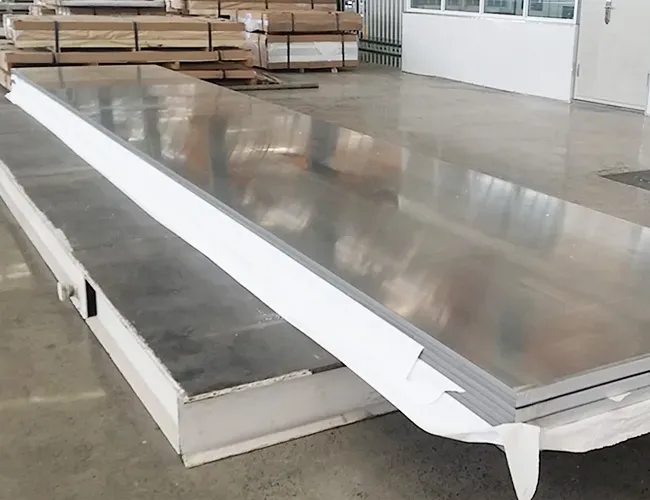
When specifying sheet metal for commercial manufacturing, structural enclosures, or transportation components, choosing between 3003-H14 and 5052-H32 aluminum is a frequent decision point. Both non-heat-treatable alloys offer good corrosion resistance, light weight, and high workability at lower costs than 6000-series structural alloys.
Selecting the wrong grade can lead to mechanical failure from insufficient yield strength or premature pitting in corrosive environments—or unnecessary material costs when lower-tier specs would suffice.
1. Metallurgy & Chemical Composition
The performance differences between 3003 and 5052 alloys trace back to their principal alloying additions: Manganese (Mn) for the 3000-series vs. Magnesium (Mg) for the 5000-series.
3003-H14 Chemical Profile
- Base Aluminum (Al): ~98.0%
- Manganese (Mn): 1.0 - 1.5% (Corrosion resistance & Formability)
- Copper (Cu): 0.05 - 0.20%
- Impurities: Fe: 0.7% max | Si: 0.6% max
5052-H32 Chemical Profile
- Base Aluminum (Al): ~97.2%
- Magnesium (Mg): 2.2 - 2.8% (Tensile strength & Saltwater resistance)
- Chromium (Cr): 0.15 - 0.35% (Grain refinement)
- Impurities: Fe: 0.4% max | Si: 0.25% max
- 3003 Alloy Mechanism: Manganese adds strength over pure 1100-series aluminum through solid solution strengthening without reducing ductility. Iron and silicon impurities are bound into $Al_6(Mn,Fe)$ intermetallic dispersoids, preserving atmospheric rust resistance.
- 5052 Alloy Mechanism: Magnesium provides solid solution strengthening and work-hardening response. The inclusion of Chromium ($Cr$) refines grain structure and improves resistance to stress corrosion cracking (SCC).
| Element | 3003-H14 Composition (wt%) | 5052-H32 Composition (wt%) |
| Aluminum (Al) | 96.8 - 99.0% | 95.7 - 97.7% |
| Magnesium (Mg) | — | 2.2 - 2.8% |
| Manganese (Mn) | 1.0 - 1.5% | 0.10% max |
| Chromium (Cr) | — | 0.15 - 0.35% |
| Copper (Cu) | 0.05 - 0.20% | 0.10% max |
| Iron (Fe) | 0.70% max | 0.40% max |
| Silicon (Si) | 0.60% max | 0.25% max |
| Zinc (Zn) | 0.10% max | 0.10% max |
2. Mechanical & Physical Property Comparison
Neither 3003 nor 5052 can be heat treated to gain strength; instead, their mechanical properties are established via cold working (strain hardening) and stabilizing thermal cycles.
- 3003-H14 Temper: Strain-hardened by rolling to a half-hard state without additional thermal stabilization.
- 5052-H32 Temper: Strain-hardened to a quarter-hard target, followed by low-temperature thermal stabilization ("3" designation) to prevent natural room-temperature age-softening over time.
| Engineering Metric | 3003-H14 | 5052-H32 | Unit (SI / Imperial) |
| Ultimate Tensile Strength | 140 - 180 | 210 - 260 | MPa (20 - 26 ksi) |
| Yield Strength (0.2% Offset) | 120 - 150 | 160 - 200 | MPa (17 - 23 ksi) |
| Modulus of Elasticity | 68.9 | 70.3 | GPa ($10^6$ psi) |
| Elongation at Break (1.6mm sheet) | 8 - 12% | 12 - 18% | % in 50 mm |
| Fatigue Endurance Limit | 60 | 115 | MPa (8.7 vs 16.7 ksi) |
| Shear Strength | 95 | 140 | MPa (14 vs 20 ksi) |
| Brinell Hardness (500kg load, 10mm ball) | 40 | 60 | HB |
| Density | 2.73 | 2.68 | $\text{g/cm}^3$ ($0.098\text{ lb/in}^3$) |
Mechanical Strength Comparison
3. Fabrication Performance: Forming, Welding, & Finishing
Press Brake Bending & Formability
- 3003-H14: High ductility and lower yield point make this alloy easy to form on press brakes. Sharp internal bend radii ($0.5t$ to $1.0t$) can be achieved without outer tension splitting or edge cracking. Excellent choice for deep drawing and spun metal shapes.
- 5052-H32: Highly formable, but requires slightly larger minimum bend radii ($1.0t$ to $1.5t$) to avoid surface micro-crazing along bend lines due to its higher yield strength.
Fusion Welding (TIG/MIG)
Both grades feature high weldability via Gas Tungsten Arc Welding (GTAW/TIG) and Gas Metal Arc Welding (GMAW/MIG).
- Filler Selection: ER4043 filler rod works well for general structural joining of either alloy. If the welded component requires post-weld anodizing or marine salt immersion, specify ER5356 filler to match the magnesium matrix of 5052 and prevent galvanic oxidation along the weld bead.
Anodizing & Surface Finishing
- 3003-H14: Anodizes reliably for functional corrosion resistance, but manganese dispersoids cause a light grayish or cloudy tint under clear protective anodizing.
- 5052-H32: Produces a uniform, bright finish when clear or color anodized, making it the preferred choice for visible architectural trims, consumer electronics housings, and cosmetic panels.
4. Decision Matrix: Selection Guidelines
Use this matrix to match your application requirements to the appropriate alloy:
| Application / Requirement Profile | Recommended Alloy | Justification |
| Submerged Marine / Salt Spray | 5052-H32 | $Mg$ content forms a protective film resistant to $Cl^-$ pitting. |
| Deep Drawn Shells / Complex Stamping | 3003-H14 | Lower yield strength and strain hardening rate prevent tearing. |
| Heavy Transportation / Trailer Panels | 5052-H32 | Higher shear and fatigue limits resist road vibration stresses. |
| HVAC Ductwork & Heat Exchangers | 3003-H14 | High thermal conductivity ($190\text{ W/m}\cdot\text{K}$) and lower material cost. |
| Cosmetic Architectural Trim (Anodized) | 5052-H32 | High clarity under protective anodized coatings. |
| Cost-Sensitive Enclosures (Indoor) | 3003-H14 | Lower raw material cost; sufficient atmospheric rust protection. |
5. Frequently Asked Questions
Can you weld 3003-H14 directly to 5052-H32 aluminum?
Yes, 3003-H14 and 5052-H32 can be welded together using TIG or MIG welding processes. ER4043 filler metal provides high fluidity and crack resistance during cooling. If the assembly will be exposed to marine environments or subject to clear anodizing, use ER5356 filler instead.
Why is 5052-H32 better suited for marine applications than 3003-H14?
5052 aluminum contains 2.2% to 2.8% magnesium. This addition forms a stable, self-healing oxide layer ($Al_2O_3\cdot MgO$) that resists chloride ion attack in salt water. While 3003 offers good atmospheric corrosion resistance, it lacks long-term protection against pitting in continuous marine environments.
How does temper designation affect 3003-H14 and 5052-H32 formability?
Both alloys are non-heat treatable and gain strength through cold work. The H14 designation indicates strain-hardening to a half-hard state via rolling. The H32 designation indicates strain-hardening to a quarter-hard state followed by low-temperature thermal stabilization to prevent room-temperature age-softening. Both offer strong press brake formability, though 3003-H14 accommodates tighter bend radii without cracking.
What is the typical price difference between 3003-H14 and 5052-H32 sheet stock?
3003-H14 is generally 15% to 25% cheaper per pound than 5052-H32. The price premium for 5052 stems from magnesium alloying additions and processing steps required to thermally stabilize the sheet during rolling.
Which alloy achieves a better cosmetic finish after anodizing?
5052-H32 achieves a clearer, more uniform finish under protective or decorative anodizing. 3003-H14 tends to take on a slightly grayish tint due to manganese intermetallic dispersoids within its matrix.
Comments ()