
Automatic Full Servo Screen Printing Machine: A Complete Procurement Guide
An expert procurement guide to buying automatic full servo screen printing machines. Learn technical specs, pricing breakdowns, changeover efficiencies, and supplier audit steps
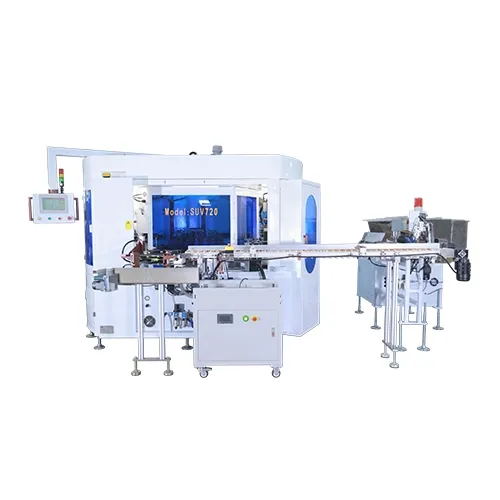
Last month, I was at a cosmetic packaging plant in Guangzhou helping a client troubleshoot a newly installed multi-color printing line. They had opted for a cheaper semi-mechanical printer to save $40,000 upfront. The result? Their scrap rate hit 14% on oval lotion bottles due to registration drift, and changing over print jobs took their team nearly four hours of manual mechanical tweaking. They were bleeding profit on wasted ink, discarded containers, and idle labor.
From my 12 years of on-site procurement experience across factories in Jiangsu and Guangdong, I can tell you directly: if your plant handles high-precision, multi-color, or complex container printing (tubes, bottles, jars, or caps), an Automatic Full Servo Screen Printing Machine is no longer a luxury—it is the baseline for operational efficiency.
In this guide, I will break down how full-servo screen printers work, what technical parameters actually matter, how to avoid supplier tricks, and what you should expect to spend.
Section 1: Mechanical vs. Semi-Servo vs. Full Servo — What Are You Paying For?
Understanding the core mechanical differences is critical before signing any purchase agreement. Traditional printers rely on physical cams, gears, and pneumatic cylinders to synchronize container rotation with screen frame travel. Full servo systems replace those wear-prone mechanical connections with independent, synchronized electronic axes.
| Feature / Metric | Traditional Mechanical / Pneumatic | Semi-Servo (Hybrid) | Full Servo (Multi-Axis) |
| Registration Precision | $\pm 0.3 \text{ mm} - \pm 0.5 \text{ mm}$ | $\pm 0.2 \text{ mm}$ | $\pm 0.05 \text{ mm} - \pm 0.1 \text{ mm}$ |
| Changeover Time | 2.5 to 4 Hours (Tooling/Cams) | 1 to 1.5 Hours | 15 to 30 Minutes (Recipe recall) |
| Container Shape Flexibility | Standard round only | Round & basic oval | Round, Oval, Flat, Square, Conical |
| Maintenance & Wear | High (Cam wear, chain stretch) | Moderate | Low (Direct-drive motors) |
| Scrap Rate Impact | $5\% - 10\%$ average | $2\% - 4\%$ average | $< 1\%$ target |
Insider Tip 1:
Do not confuse "Servo-Driven Main Drive" with "Full Servo." Unscrupulous vendors will advertise a "Servo Screen Printer" when only the rotary indexer or screen drive uses a servo motor, while squeegee motion, height adjustment, and registration rely on standard pneumatics. A true full-servo machine utilizes 5 to 12 independent servo axes per printing module.
Section 2: Key Technical Architecture to Inspect On-Site
When you conduct a factory acceptance test (FAT) or pre-shipment inspection, ignore the painted exterior covers and audit these five core hardware subsystems:
1. Motion Control & Servo Hardware
Verify that all servo drives, motors, and motion controllers originate from a unified, Tier-1 automation ecosystem (e.g., Siemens, Panasonic, Yaskawa, or Schneider). Mixed-brand "Frankenstein" systems often lead to communication delays between axes, causing subtle registration ghosting at high speeds.
2. Registration Systems (Optical vs. Mechanical)
For multi-color printing without physical registration notches on your container base, high-resolution optical vision sensors (such as Keyence or Cognex) are essential. Ensure the system can read both contrasting optical registration marks and subtle glass/plastic mold seams.
3. Surface Pre-Treatment Modules
Inks will not adhere to non-polar plastics like Polyethylene (PE) or Polypropylene (PP) without proper surface treatment. Ensure the machine integrates high-efficiency flame treatment units or corona discharge stations inline before station one.
7-Stage Automated Screen Printing Process Flow
- Automatic Unscrambler & Feeding: High-speed automated container orientation and feeding system for continuous inline production.
- Dust Removal & Deionizing: Static-elimination air knives clean container surfaces prior to ink application.
- Flame / Corona Pre-Treatment: High-efficiency surface treatment enhancing ink adhesion on PE, PP, and PET substrates.
- Optical Mark Registration: High-precision vision sensors detecting registration marks for micro-aligned multi-color printing.
- Servo Screen Print Station(s): Multi-axis servo control enabling smooth, uniform ink deposition on round, oval, and flat containers.
- LED-UV Curing: Instant inline LED-UV drying that prevents heat deformation and reduces energy consumption.
- Auto Discharge: Automated robotic discharge transferring printed containers to downstream packaging lines.
4. Curing Technologies (Traditional UV vs. LED-UV)
Demand modern LED-UV curing units over traditional mercury vapor lamps. LED-UV provides instant on/off control, generates minimal thermal heat (preventing thin-walled plastic tubes from warping), and reduces electricity consumption by up to 40%.
Section 3: Container Flexibility — Tubes, Bottles, and Complex Geometries
A major advantage of full-servo motion architecture is digital tracking on irregular shapes.
- Round Containers: The container fixture turns in perfect 1:1 gear-ratio synchronization with the linear movement of the silk screen frame, allowing smooth $360^\circ$ continuous wrap printing.
- Oval Containers: The servo motor continuously adjusts container height (Z-axis offset) and surface angle relative to the stationary squeegee to maintain consistent impression pressure along the curve.
- Square and Flat Surfaces: Linear servo axes lock in parallel motion to execute high-speed, flat-bed print strokes without mechanical index slap.
Section 4: Realistic Investment Breakdown & ROI Calculations
Investing in automatic full-servo screen printing equipment requires looking beyond the base equipment price tag.
Budget Expectations (2026 Market Standard)
- Single-Color Automatic Full Servo Line: $\$45,000 - \$75,000\text{ USD}$
- 3-to-5 Color Integrated Full Servo Line (In-line UV Curing & Vision): $\$130,000 - \$260,000\text{ USD}$
- High-Speed Fully Automatic Multi-Station Line (up to 8 colors): $\$300,000 - \$450,000+\text{ USD}$
Installation & Operational Contingencies
Always budget an additional 10% to 15% over equipment cost to cover:
- Custom quick-change chucks and mandrel tooling sets for your specific container line-up.
- Spare parts package (squeegee blades, flood bars, spare servo drives, optical sensors, UV lamps).
- On-site commissioning, electrical utility hookups, and operator training.
Insider Tip 2:
Inquire about real electricity draw under full UV curing load. Standard mercury lamps spike utility bills drastically. Opting for integrated LED-UV curing can save upwards of $\$8,000 - \$15,000\text{ USD}$ annually per line in plant energy costs alone.
Section 5: Distinguishing Tier-1 Machinery Builders from Assembly Shops
During my visits to over a dozen equipment manufacturers in Eastern China, I discovered that many "manufacturers" simply assemble imported or local generic components in rented warehouse spaces without dedicated software engineering teams.
Here are 3 concrete steps to verify your supplier:
- Demand a 3-Hour Continuous Run Test: Bring or ship 2,000 of your actual production containers. Run the line continuously at rated speed (e.g., $3,000 - 4,200 \text{ pcs/hour}$). Watch for thermal drift in the servo motors and verify registration accuracy from tube #1 to tube #2,000.
- Review Software Control & HMI Usability: Ask the engineers to demonstrate adding a brand-new custom oval tube profile on the HMI touch screen. If this requires modifying backend PLC code instead of inputting simple geometric dimensions via the user interface, walk away.
- Verify Compliance and Component Traceability: Ensure the CE marking is backed by complete machinery directive documentation, safety light curtains, and localized safety relay integration.
Real Industry Case:
A contract cosmetic packager in Guangdong upgraded from 3 semi-mechanical single-color printers to an integrated 4-color full servo screen printing machine in late 2025. By eliminating manual multi-pass registration setups, they cut their production lead times by 65%, lowered job changeover times from 3 hours to 20 minutes, and brought scrap rates down from 8.5% to under 0.4%.
Section 6: Pre-Contract Checklist — Final Safeguards
Before issuing a deposit or opening an L/C, ensure the contract explicitly includes the following items:
- Clear Registration Tolerance Specification: Guarantee registration precision of $\le \pm 0.1\text{ mm}$ at max rated operating speed across all print stations.
- Toolless Changeover Mandate: Specify that job changeovers between standard diameter sets must require zero specialized mechanical machining or custom physical cams.
- Component Brand Guarantee: An itemized bill of materials (BOM) attached as a contract appendix detailing explicit brand names for servos, PLCs, pneumatics, and vision sensors.
- 12-Month Comprehensive On-Site Warranty: Warranty terms covering servo drives, motors, PLCs, and optical sensors—not just basic mechanical frames.
At the end of the day, a suitable automatic full servo screen printing machine is not the one with the most fancy functions, but the one that can run stably 16 hours a day and bring you qualified products for 10 consecutive years.
FAQ: Automatic Full Servo Screen Printing Machine
What is this full servo screen printing machine used for?
The automatic full servo screen printing machine is used for tube decoration in packaging production. It is suitable for tube manufacturers that need stable screen printing on tube bodies and want to compare model options by printing speed, stroke, printing length, available tube diameter, UV lamp power, air pressure, electricity requirement, power, machine size and machine weight.
Which model range is listed on the page?
The page lists SUV416, SUV516, SUV620 and SUV720 models. The table shows a maximum printing speed of 80 pcs/min, maximum printing stroke of 220 mm, maximum printing length of 200 mm and available printing diameter of 13-60 mm for the listed model range. Final selection should be confirmed according to tube size, decoration requirements and factory utilities.
What information is needed before quotation?
Before quotation, buyers should provide tube diameter and length, tube material, printing colors, target output, UV curing preference, available electricity, compressed air conditions and space limits. These details help confirm whether the listed model range fits the project.

Comments ()