
Slovalco Primary Aluminium Restart 2026: Policy Frameworks, Carbon Cost Mitigation, and Europe's Industrial Strategy
An engineering and policy breakdown of Slovalco's agreement with the Slovak government to restart 75,000 tonnes of primary aluminium capacity by Q4 2026, examining power purchase agreements, ETS indirect cost compensation, and European supply chain resilience.
Primary aluminium production represents one of the most energy-intensive manufacturing processes in modern heavy industry. The announcement that Slovalco—majority-owned by Norsk Hydro—has reached a regulatory and financial framework agreement with the Slovak government to restart 75,000 tonnes of curtailed primary aluminium capacity by Q4 2026 marks an operational turning point for the European metals sector.
Since the onset of the European energy crisis in 2022, over half of the European Union's primary aluminium production capacity was forced offline. Unprecedented wholesale power price spikes, coupled with inconsistent national implementations of EU Emissions Trading System (ETS) indirect carbon cost compensation rules, rendered European smelters structurally uncompetitive against international producers operating in regions with long-term, low-cost power structures.
Re-establishing 75,000 tonnes of primary capacity at Žiar nad Hronom demonstrates that industrial capacity can return to Europe when sovereign energy, carbon, and trade policy frameworks align to establish stable long-term operating conditions.
Technical & Economic Drivers of the Slovalco Restart
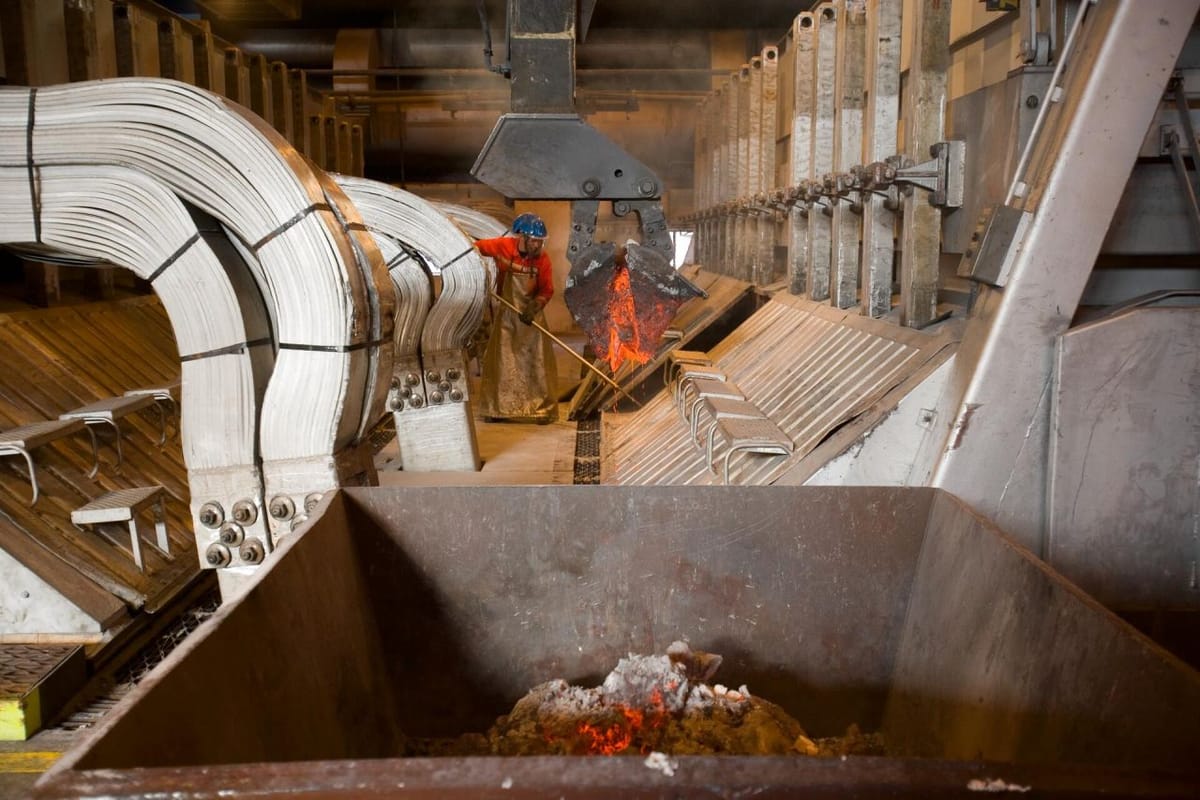
Primary aluminium is produced via the Hall-Héroult electrolytic reduction process, in which alumina ($\text{Al}_2\text{O}_3$) is dissolved in a molten bath consisting primarily of cryolite ($\text{Na}_3\text{AlF}_6$) at operational temperatures around 950°C. Passing direct electric current through the cell reduces alumina to elemental liquid aluminium at the cathode while oxidizing prebaked carbon anodes into carbon dioxide.
Because electrical power represents between 35% and 50% of the total cash cost of primary smelting, operating margin stability relies heavily on energy contracts rather than raw material spot markets alone.
The Three Required Pillars for European Smelter Viability
- Long-Term Power Purchase Agreements (PPAs): Smelters operate as continuous baseload loads, requiring 24/7 power drawing hundreds of megawatts. Exposure to volatile day-ahead spot electricity markets exposes operations to severe financial risk. Secure, multi-year bilateral PPAs linked to nuclear, hydroelectric, or dedicated renewable generation are necessary to establish clear operational cost ceilings.
- Predictable EU ETS Indirect Carbon Cost Compensation: In the EU, power generators pass carbon allowance costs ($\text{CO}_2$ price per tonne under EU ETS) through to industrial consumers via electricity prices. To prevent "carbon leakage"—where production shifts to non-EU nations with higher emission intensity—EU state aid rules allow member states to compensate electro-intensive industries for these indirect emissions. Predictable national implementation of these rules is required for long-term operational feasibility.
- Transmission Grid Tariff Design: As massive, highly predictable baseload loads, smelters provide crucial grid stability features, including frequency response and interruptibility service options. National tariff structures must reflect these balancing services to avoid overcharging continuous consumers for grid maintenance.
Primary vs. Secondary Aluminium: Performance & Technical Requirements
A common question in European industrial policy is why primary smelting capacity remains essential when secondary (recycled) aluminium production uses ~95% less energy per kilogram.
While recycling scrap is critical for circularity, secondary metal cannot fully replace primary aluminium due to metallurgical purity limits and alloy specifications required by high-performance sectors.
| Metric / Attribute | Primary Aluminium (Hall-Héroult Reduction) | Secondary / Recycled Aluminium (Scrap Remelting) |
| Specific Energy Consumption | ~13.5–15.0 MWh / tonne | ~0.5–0.8 MWh / tonne |
| Purity Level | Extremely high (typically $\ge 99.7\%$ $\text{Al}$) | Variable, subject to input scrap quality |
| Impurity Profiles ($\text{Fe, Si, Cu, Zn}$) | Precisely controlled during electrolysis/alloying | Accumulates tramp elements over multiple recycle loops |
| Key Target Applications | High-voltage electrical conductors, critical aerospace alloys, high-formability automotive body sheet | Die-cast engine blocks, structural castings, general extrusion profiles |
| Decarbonization Pathway | Renewable/Nuclear PPA power, Inert Anode technologies | Optimized sorting, advanced scrap decontamination, low-emission melting furnaces |
| Raw Material Source | Bauxite $\rightarrow$ Alumina ($\text{Al}_2\text{O}_3$) | Pre-consumer and post-consumer scrap streams |
Metallurgical Realities: The Tramp Element Problem
Repeated recycling leads to the gradual accumulation of tramp elements—particularly iron ($\text{Fe}$) and silicon ($\text{Si}$)—which cannot be easily refined out of molten aluminium during standard remelting.
High concentration of iron forms brittle intermetallic phases (e.g., $\beta\text{-Al}_5\text{FeSi}$), which severely degrade ductile performance, deep-drawing capabilities, and fatigue resistance.
As a result, meeting high-spec engineering requirements—such as 6000-series structural automotive extrusions or high-voltage electrical cable wire rod—requires blending recycled scrap with virgin primary aluminium to dilute residual tramp element concentrations down to strict specification thresholds.
Decision Matrix: When Primary Metal Availability Dictates Materials Selection
For design engineers and supply chain strategists, choosing between primary-dominated alloys and secondary-dominated scrap melts involves balancing mechanical property requirements against carbon footprint targets.
| Application Demand | Primary Metal Blend Required? | Technical Rationale |
| High-Voltage Transmission Cable Wire Rod (1350 Alloy) | Yes (Mandatory) | Requires electrical conductivity $\ge 61.0\%$ IACS. Trace iron/silicon impurities significantly lower electron mobility and increase resistivity losses. |
| Automotive Crash-Relevant Structural Components | Yes (High Primary Ratio) | Demands high elongation at break ($\gt 12\%$) to absorb impact energy without brittle fracture. Low iron thresholds are required to prevent micro-cracking. |
| Architectural Window Frames & Standard Profiles | No (High Recycled Ratio) | Standard 6063-T6 alloys accept moderate secondary content provided scrap sorting keeps zinc and iron levels within standard tolerance limits. |
| Automotive Engine Powertrain Castings | No (Secondary Preferred) | Cast alloys (e.g., A380, A356) utilize higher silicon content ($7\text{--}11\% \text{ Si}$) to optimize melt fluidity during casting, making them ideal scrap sinks. |
Smelter Restart Mechanics: Re-activating a Curtailed Hall-Héroult Facility
Recommissioning a curtailed primary smelter is a complex, capital-intensive engineering undertaking. Potlines cannot simply be powered back on via a circuit breaker; the re-activation process involves strict thermal and chemical preparation protocols.
- Cell Inspection & Cathode Relining: Each individual reduction pot must be inspected. Cells that underwent cold shutdown require complete mechanical excavation of the old cathode bed, followed by installing new refractory insulation, carbon cathode blocks, and ramming paste.
- Anode Assembly & Pot Bake-In: Prebaked carbon anodes are positioned within the cell superstructure. Gas burners or electrical resistance heating are used to gradually ramp pot temperatures to prevent thermal shock to the newly installed refractory materials.
- Bath Melting & Liquid Metal Generation: Molten cryolite bath is introduced, and direct current is gradually applied. Cell voltage is carefully adjusted until electrolyte equilibrium temperature (~950°C) and target chemical composition are re-established.
- Alumina Dosing & Process Control Calibration: Automated point-feeder systems are calibrated to inject alumina based on real-time cell resistance measurements, minimizing the occurrence of anode effects (which produce unwanted PFC greenhouse gases like $\text{CF}_4$ and $\text{C}_2\text{F}_6$).
Policy Implications: Securing Strategic Raw Materials in Europe
The restart of Slovalco's 75,000-tonne capacity represents a key development in the context of Europe's Critical Raw Materials Act (CRMA) and broader Net-Zero Industry objectives. Primary aluminium is explicitly designated as a critical strategic material necessary for:
- Solar Photovoltaic Infrastructure: Structural mounting frames, inverter heat sinks, and collector elements.
- Electrical Grid Expansion: High-voltage transmission conductor lines, substation busbars, and transformer windings.
- Electric Vehicle Manufacturing: Lightweight battery enclosures, structural chassis components, and heat exchangers.
Relying on imported primary aluminium from regions with high-carbon power grids (e.g., coal-fired generation exceeding 15 to 20 kg $\text{CO}_2$ per kg of $\text{Al}$) counteracts global net-zero goals. By contrast, European smelters like Slovalco operate under strict environmental controls, utilizing hydro or nuclear-heavy energy mixes that yield significantly lower embedded carbon footprints ($\lt 4.0\text{ kg CO}_2\text{/kg Al}$).

Comments ()