

The Ultimate Guide to Custom Aluminum Extrusion Die Design and Cost Optimization
A comprehensive guide to custom aluminum extrusion die design (DFM) and cost optimization. Learn how wall thickness, tongue ratios, alloy selection, and tooling maintenance directly impact total production cost.
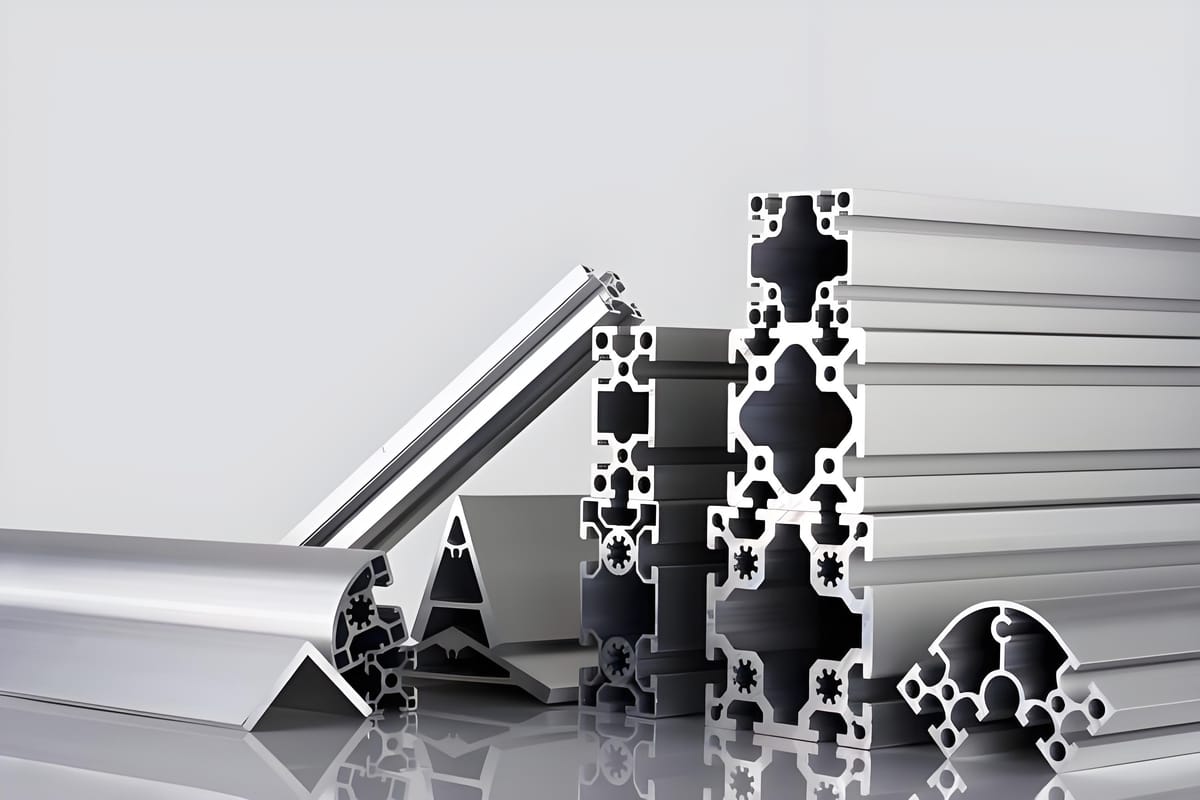
When developing custom aluminum extrusions, product designers and procurement managers often focus heavily on upfront tooling charges. However, over a full production lifecycle, the die design itself dictates scrap rates, press run speeds, and downstream machining expenses—factors that dwarf initial tooling capital.
A well-optimized Design for Manufacturability (DFM) approach extends tool life while increasing press throughput by over 30%. This guide breaks down the core principles of die architecture, DFM parameters, financial optimization strategies, and longevity protocols.
1. Die Types and Mechanical Architectures
The profile's cross-sectional geometry dictates the fundamental structure of the die set. Tooling generally falls into two core categories: Solid Dies and Hollow (Porthole/Bridge) Dies.
| Feature | Solid Dies | Hollow / Bridge Dies |
|---|---|---|
| Profile Type | Angles, flats, channels, open shapes | Tubes, square pipes, multi-hollow cavities |
| Tool Assembly | Single disc or two-piece (feeder + die) | Multi-piece (mandrel/bridge plate + cap) |
| Metal Flow Mechanism | Direct pressure through die aperture | Billet splits around bridges and re-welds under high pressure in weld chamber |
| Relative Tooling Cost | Baseline (1x) | 2.0x to 3.5x baseline |
| Tooling Steel | Premium H13 / SKD61 Tool Steel | High-stress H13 / Premium Hot-Work Tool Steel |
2. Design for Manufacturability (DFM) Rules
To prevent die deflection, premature cracking, or uneven flow velocities, cross-sections must comply with key physical parameters:
Wall Thickness Uniformity
- Rule: Maintain consistent wall thickness across the entire cross-section wherever possible.
- Mechanism: Uneven walls cause velocity differentials during extrusion. Aluminum flows faster through thick areas and slower through thin areas, resulting in twisting, warping, and unwanted residual stress.
- Transitions: If thickness variation is required, use gradual blend transitions with a maximum ratio of 1.5:1 and generous radius fillets.
Tongue Ratio Limits
The "tongue" refers to the steel protrusion on a die that creates a channel or slot in the extruded profile.

- Safe Target: Keep the tongue ratio below 3:1 for standard 6063 alloy.
- High-Risk Threshold: Ratios exceeding 4:1 subject the steel tongue to severe bending moments, sharply increasing the risk of tool breakage on press.
Radii and Fillets
- Avoid Sharp Corners: Never specify zero internal or external radii ($R = 0$).
- Target Spec: Apply a minimum radius of 0.5 mm to 1.0 mm on all corners. Internal corner radii help redistribute stress concentrations in H13 steel, delaying thermal fatigue micro-cracking.
Symmetry and Circumscribing Circle Diameter (CCD)
- Symmetry: Balanced cross-sections distribute extrusion pressure evenly across the die face, preventing lateral stem thrust.
- CCD Minimization: Keep the smallest possible Circumscribing Circle Diameter (CCD). Smaller CCD profiles run on lower-tonnage presses, lowering hourly machine rates.
3. Total Lifecycle Cost Optimization
Overall component cost is governed by the following breakdown:
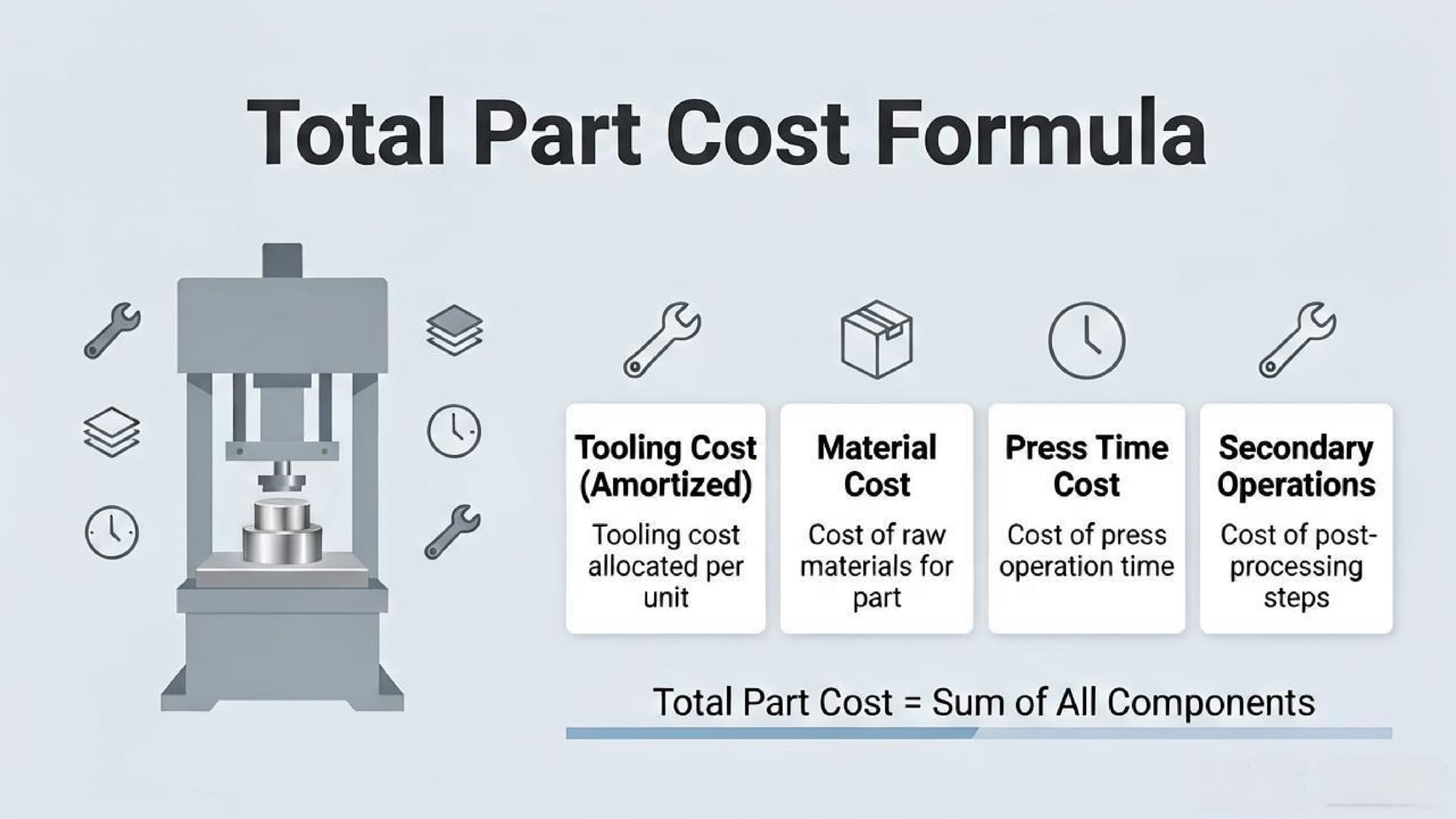
To minimize net unit costs, execute these design strategies:
Multi-Cavity Layouts
For small profiles, design multi-cavity dies (2, 4, or 8 openings). Multi-cavity tooling doubles output per press stroke, dramatically reducing per-kilogram machine time expenses. Ensure a minimum 25 mm clearance from the container wall to avoid boundary shear turbulence.
Integrated Functional Features
Incorporate functional features into the profile orifice to eliminate post-extrusion CNC operations:
- Screw Bosses: Design self-tapping screw channels directly into the cross-section.
- Snap Joints & Hinges: Utilize aluminum's elastic modulus to create inter-locking snap-fit assemblies, removing hardware requirements.
Alloy Selection vs. Production Speed
- 6063 Alloy: Offers superior extrudability and surface finish. Press speeds reach 50–80 m/min with minimal die wear.
- 6061 Alloy: Provides higher structural strength but increases flow resistance. Extrusion speeds drop by ~20%–30%, pushing up machine-hour costs and accelerating die wear.
4. Die Maintenance & Longevity Protocols
A well-maintained extrusion die typically yields between 15,000 kg and 50,000 kg of extruded aluminum over its operational life:
- Pre-Heating Discipline: Always preheat dies in controlled ovens to match billet temperature (~450°C–480°C) before press loading to prevent thermal shock failure.
- Gas Nitriding Cycles: Apply gas nitriding after initial trial runs and every subsequent 5,000–10,000 kg of production. This forms a hard surface layer (65–70 HRC) that resists aluminum adhesion and friction wear.
- Bearing Length Tuning: Fine-tune die bearing lengths across the orifice (longer bearings on thick sections, shorter on thin sections) to equalize exit velocity without excessive press power.
Frequently Asked Questions (FAQ)
Q1: What is the typical cost and lead time for a custom extrusion die?
Answer: Standard solid dies (CCD < 150mm) generally range from $500 to $1,500 USD. Complex hollow or large-diameter dies range from $1,800 to $5,000 USD. Standard lead times for die fabrication and initial sample testing are typically 10 to 15 business days.
Q2: Why do very thin wall thicknesses increase tooling costs?
Answer: Wall thicknesses under 1.0 mm require substantially higher extrusion pressure. This demands higher-grade hot-work tool steels and subjects the die bearings to rapid wear, requiring more frequent maintenance and shorter overall die lifespans.
Q3: How does die design differ between 6061 and 6063 alloys?
Answer: 6061 alloy has higher flow stress than 6063. Dies for 6061 feature shorter bearing lengths, larger feed pockets, and require die steels with superior toughness to handle the higher extrusion pressures.
About the Author
wade shen | Senior Materials & Manufacturing Engineer
wade has over 14 years of experience in aluminum extrusion engineering, die flow simulation (QForm/AutoForm), and B2B component manufacturing. He has led tooling development projects for EV battery enclosures, solar mounting systems, and high-density heat sinks, helping clients save millions in tooling and machining costs through DFM optimization.
Comments ()